
The guitar rewards you faster than most instruments. After a few weeks of steady work a student can play and sing a first song, and after a year they have a repertoire they can show the family at the dinner table. At the same time it is an instrument on which bad habits set in very easily, and you can then spend years fighting a tense wrist and chords that refuse to ring cleanly. That is exactly why the first guitar teacher matters so much.
Fourteen years teaching guitar
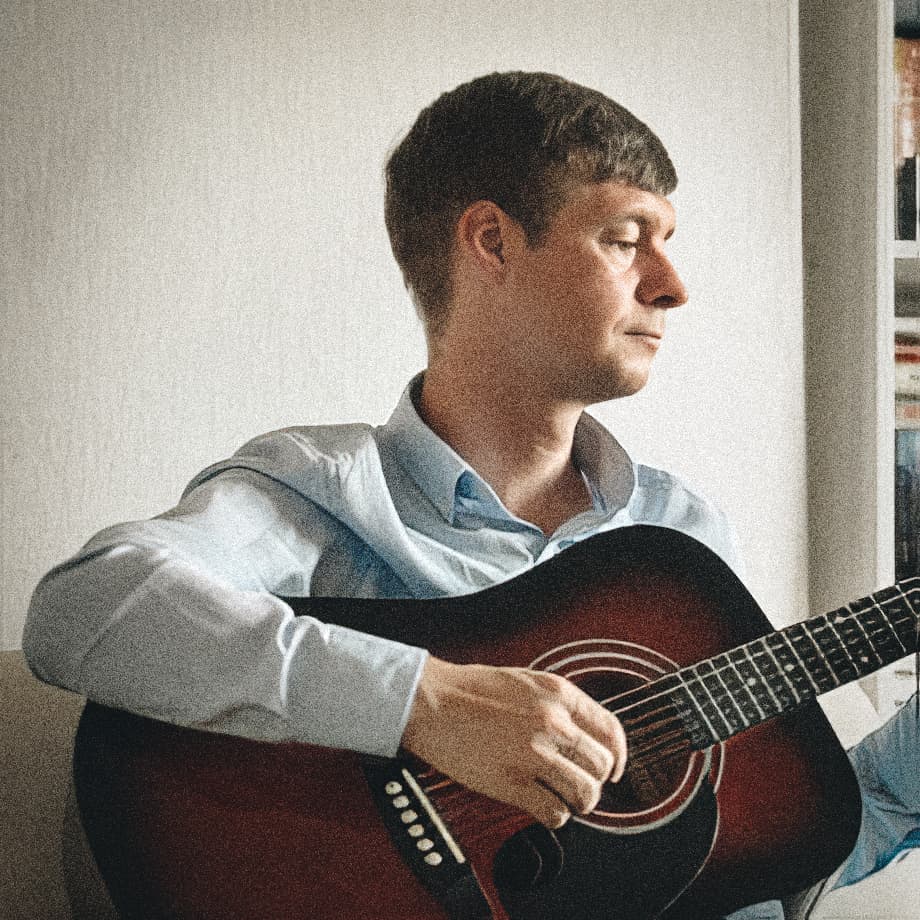
Piotr Bielski has taught guitar since 2012. He began at a first-level music school in Mstsislaw, where he ran the guitar class for two years. For the following decade, from 2014 to 2024, he taught guitar at a general school in Mogilev, running extracurricular classes, individual consultations and preparing students for performances. In parallel, between 2023 and 2024, he led the guitar class at a second-level music school in the same city.
In 2014 he spent a semester teaching at a music school in Rugao, China, working with children who spoke a different language and had grown up in a different musical culture. That experience turned out to be unexpectedly useful in Warsaw, where the Unisono classrooms bring together students from more than a dozen countries. Piotr Bielski has lived and worked in Poland since 2025. Alongside Unisono he teaches guitar and piano at the Municipal Cultural Centre in Piastów.
Musical education
Piotr Bielski completed the full three-stage path of musical training. He began his professional studies at a second-level music school in Mogilev, where he studied the domra from 2003 to 2007. He completed a master’s degree on the same instrument in 2012 at the Belarusian State Academy of Music, graduating with a teaching qualification. Between 2020 and 2021 he studied guitar at the Belarusian State University of Culture and Arts in Minsk, in the department of folk instrument performance.
From the domra to the guitar
Piotr Bielski’s first instrument was the domra, a plucked instrument with metal strings played with a pick, which in the Eastern European tradition fills a role close to that of the mandolin. It is an unusual starting point for a guitarist and a very practical one. The domra demands precise right-hand work, an even tremolo and clean intonation, and every one of those habits transfers directly to the guitar.
Students usually notice this during their first exercises with a pick, when he breaks the wrist movement down into its component parts and shows where an uneven tone actually comes from. Day to day he teaches steel-string acoustic guitar and nylon-string classical guitar. He also teaches piano basics, which comes in useful when explaining harmony and chord construction.
At Unisono Music Academy, guitar tuition is led by Piotr Bielski, a teacher with fourteen years of experience in first- and second-level music schools. Lessons are individual and take place at our premises at ul. Konstancińska 9 flat 1 in the Mokotów district of Warsaw.
The first lesson
The first meeting is exploratory and requires no preparation. Piotr Bielski checks how the student holds the instrument, how their hand is built and how they respond to sound. We talk about the music the student listens to, what they expect from lessons and how much time they can realistically devote to practice at home. That last piece of information matters more than it seems, because it determines the pace of the coming months and whether the plan will actually be workable.
You do not need to bring your own instrument to the first lesson, as the school provides a guitar. In fact we ask you not to buy one beforehand, and we explain why further down this page.
Individual lessons at a fixed time
All guitar lessons are one to one. A standard lesson lasts forty five minutes and takes place once or twice a week, at a fixed time agreed at the start of the year. For the youngest students we offer thirty minute lessons, because a small child will not hold attention for longer, and for those preparing for exams or adults working on a larger repertoire we offer sixty minute lessons.
The fixed time is not a formality. Learning an instrument runs on the rhythm of the week, and lessons that keep moving from slot to slot stop producing results very quickly.
What the course covers
- Posture and hand position. The point on which it depends whether, after a year of playing, the student feels no wrist pain and can play a barre chord without clenching the whole arm.
- Right-hand technique in two forms. Playing with a pick, needed for accompaniment and popular music, and fingerstyle, without which classical literature is out of reach.
- Chords. Open chords first, then barre chords, then the most common accompaniment patterns and the ability to work out a voicing for a song independently.
- Reading notation and tablature. We teach both in parallel. Tablature lets a student quickly play what they enjoy, while notation opens up the whole literature and the exam route.
- Scales and arpeggios. Played from memory, evenly and legato, because that is what the exams require and because it is the most effective exercise for both hands.
- Music theory basics. To the extent a guitarist genuinely needs: the construction of scales, intervals and chords, and an understanding of why certain notes sound good together.
- Sight-reading and aural training. Reading at first sight and recognising by ear, both compulsory in ABRSM exams and very useful when playing with others.
- Performance preparation. Work on a piece taken all the way to the end and played in front of an audience, not merely rehearsed in the classroom.
Repertoire chosen for the student
Repertoire is set individually and usually runs on two tracks. Alongside the teaching literature, which builds technique systematically, there is always a piece the student has chosen. In practice it is usually the second one that decides whether the instrument comes out of its case midweek, and an étude only makes sense when it leads towards something the student actually wants to play.
Guitar students play early and classical music, film music arrangements, standards and whatever songs happen to interest them. Where needed, Piotr Bielski writes his own arrangements and simplifications so that a piece can be played at the student’s current level without losing its character.
Concerts at the Szuster Palace
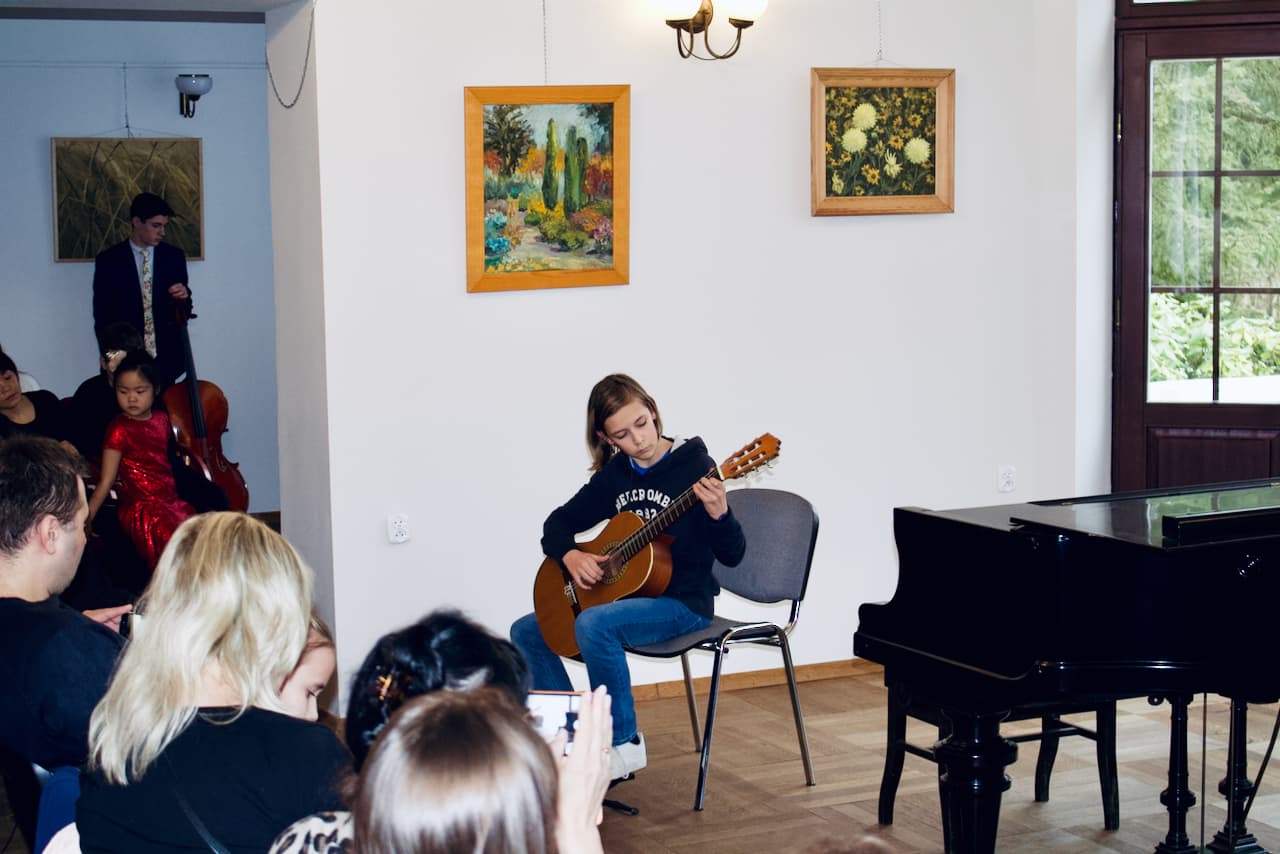
Unisono students perform several times a year at school concerts held in the Szuster Palace at ul. Morskie Oko 2 in Mokotów. This listed building is the home of the Stanisław Moniuszko Warsaw Music Society and was built between 1772 and 1774 to a design by Efraim Szreger. The concert hall sits inside a building that has served music for generations, and it makes the right impression on a young performer.
We treat performing as a permanent part of learning rather than an extra for the most gifted. Playing a piece in public is a different kind of experience from a lesson and teaches things a classroom cannot: handling nerves, carrying a piece through to the end despite a small slip, and being ready for a specific date. You can see examples of the programmes our students play in our concert reports.
ABRSM guitar exams
Students who want to confirm their skills with a qualification recognised worldwide are prepared for ABRSM examinations. Guitar is a full instrument within that system, with an eight-grade scale.
A practical guitar exam has four parts. The candidate performs three pieces, one from each of lists A, B and C, presents scales and arpeggios from memory, sight-reads and completes aural tests. The whole is marked out of one hundred and fifty points, where one hundred is a pass, one hundred and twenty a merit and one hundred and thirty a distinction.
Two things are worth knowing before you decide. First, a candidate may enter at any grade regardless of age and without taking the earlier grades, so an adult learner does not have to start at Grade 1. Second, practical exams from Grade 6 upwards require a prior pass in Grade 5 Music Theory, so for students aiming at the higher grades we plan the theory well in advance.
Who the guitar lessons are for
Guitar lessons for children
Guitar lessons can begin at around the age of seven, although what decides it is not the birth certificate but hand size and the ability to concentrate for fifteen minutes or so. Younger children learn on short-scale instruments, most often half or three-quarter size, so that they are not fighting a guitar that is physically too big for them.
With children, the teacher’s patience counts for a great deal, because progress is uneven and weeks of clear development are followed by weeks of standstill. Piotr Bielski spent ten years running guitar classes in a general school, working with the full range of pupils rather than only the exceptionally gifted. That experience shows in the way he breaks material down into smaller steps.
Teenagers and advanced students
Teenagers usually come to the guitar with a specific reason: a favourite band, the wish to accompany their own singing, or a plan to apply to a music school. With these students we work on two tracks, combining the repertoire that drew them in with the systematic technique without which that repertoire will stall at a certain level. Piotr Bielski has taught at a second-level music school, the stage at which students are already weighing up music as a profession, and he can judge whether a given student is genuinely heading that way.
Guitar lessons for adults
Adults are equally welcome. They usually arrive in one of two situations. The first is a complete beginning, when someone has wanted to learn for years and has finally found the time. The second is a return after a long break, with a few chords still in the memory and a feeling that it used to go better.
Adult students usually find the theory easier and the physical fluency harder, because mature hands need more time to develop stretch and finger independence. We then break the material into smaller stages and choose pieces that already sound good with a simple accompaniment, so that results arrive before patience runs out. We work without exam pressure and without a compulsory repertoire, unless the student decides to take ABRSM.
Lessons in Polish, Russian and Belarusian
Piotr Bielski teaches in Polish and, where needed, in Russian and Belarusian, both of which are his native languages. For families who have recently arrived in Warsaw this can be a real convenience. The child learns music without an additional language barrier, and the parent can talk to the teacher about progress and home practice without difficulty. Basic organisational arrangements can also be handled in English.
Which guitar to choose at the start
Unisono rents instruments to students who need one. Please do not buy an instrument before the first lesson. The right guitar depends on the student’s hand size, their height and the repertoire that interests them, and all three are easiest to assess in person. Piotr Bielski is glad to advise on a purchase and to check the chosen instrument before it comes to lessons.
A child starting out usually needs a nylon-string classical guitar in a size matched to their height. Nylon is far gentler on the fingertips than steel, and the wider neck makes finger placement easier. The table below is a starting point; the final decision is always made once the instrument has been tried, because children grow at very different rates.
| Guitar size | Approximate age | Approximate height |
|---|---|---|
| 1/4 | 4 to 6 years | 100 to 120 cm |
| 1/2 | 5 to 8 years | 110 to 140 cm |
| 3/4 | 7 to 11 years | 130 to 150 cm |
| 7/8 | 10 to 12 years | 140 to 160 cm |
| 4/4 | from 11 years and adults | above 150 cm |
An adult interested in accompaniment and popular music will most often reach for a full-size steel-string acoustic. In both cases a sensible beginner instrument costs a few hundred zloty, and the quality of the setup matters far more than the brand. Please look at two things: whether the guitar tunes properly and holds its tuning, and whether the strings sit too high above the fingerboard. Action set too high is the most common reason a child says after a month that playing the guitar hurts.
Frequently asked questions
At what age can a child start learning the guitar?
Most often around the age of seven, when the child’s hand is large enough to hold the neck of a half-size guitar comfortably. Very able and focused children start earlier, on a quarter-size instrument. There is no upper age limit, and it is never too late to learn the guitar.
How much practice is needed at home?
Fifteen to twenty minutes a day is enough at the start, but it has to be regular. Short daily practice gives clearly better results than one long session the night before the lesson, because guitar playing rests on motor memory, and that is built by repetitions spread over time. For students preparing for an exam the time rises to forty five minutes or an hour.
Do I need to read music?
No. We start notation and tablature from zero and teach them alongside playing. A student usually plays their first piece before they have mastered reading, and that is exactly as it should be.
Do the fingers hurt at first?
For the first two or three weeks the fingertips of the left hand can be tender, after which the skin hardens and the discomfort passes. This is normal and every guitarist goes through it. Pain in the wrist, forearm or shoulder is not normal and always means an error in hand position or a badly chosen instrument, so please report it immediately.
What is the difference between a classical and an acoustic guitar?
A classical guitar has nylon strings, a wider neck and a soft, warm tone, and is played mainly with the fingers. An acoustic guitar has steel strings, a narrower neck and a louder, brighter sound that works well for accompaniment. For children we almost always recommend starting on a classical; for adults it depends on the music they want to play. Piotr Bielski teaches both.
Can I start in the middle of the school year?
Yes. Lessons are individual, so a student is not joining a group and has nobody to catch up with. The only limit is the availability of free slots during the week, so please get in touch early.
Does a student have to perform at concerts?
We encourage performing, because it speeds up development considerably, but nobody is forced. Shy students usually begin by playing a duet with their teacher, which takes away a good deal of the tension, and only later decide on a solo appearance.
Does the school prepare students for exams?
Yes. We prepare students for ABRSM guitar examinations at all eight grades, and for entrance exams to Polish state music schools.
Enrolment for guitar lessons in Warsaw
We invite you to guitar lessons at Unisono Music Academy, ul. Konstancińska 9 flat 1, in the Mokotów district of Warsaw. Places in Piotr Bielski’s class are limited, because every lesson is individual and takes place at a fixed time. For available slots and to book a first lesson, please use our contact form or call us.
You are also welcome to read about the rest of our teaching staff on the teachers page and to visit the gallery with recordings from our students’ concerts.