Elwira Janasik is a mezzo-soprano who appears regularly on opera stages in Poland and abroad, a soloist of the Grand Theatre National Opera, with a body of work covering radio, television and disc recordings. At Unisono Music Academy she teaches classical singing and voice production, from the first breathing exercises through to preparing a repertoire for auditions and examinations.
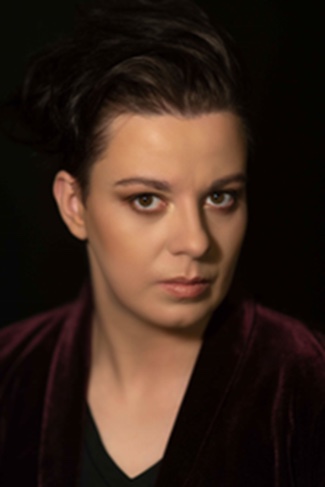
If you are looking for a singing teacher in Warsaw who performs in front of audiences herself, lessons with Elwira Janasik combine solid vocal craft with stage practice. We work on technique, but also on what happens to the text, the phrase and the emotion in a particular aria, song or oratorio part.
Her repertoire is unusually broad for a single voice. It takes in the Italian baroque and Monteverdi, the great mezzo-soprano roles of Mozart, Verdi, Wagner and Puccini, Polish romantic song, and the newest music, including world premieres written specifically for this voice type. That range feeds directly into her teaching: the student gets a teacher who knows the demands of different styles in practice, not merely one slice of the vocal literature.
Elwira Janasik, mezzo-soprano and voice teacher
Education and early career
Elwira Janasik began her musical education at a first-level music school, in the violin class of Zofia Zwolińska. She graduated from the Vocal and Acting Faculty of the Fryderyk Chopin University of Music in Warsaw, in the solo singing class of Professor Ryszard Cieśla. She has held scholarships from the Polish Ministry of Culture and National Heritage on several occasions, as well as a scholarship from the Pro Polonia Society Foundation.
She appeared on the professional stage before graduating. In 2013 she sang Dorabella in “Così fan tutte” in the first opera production in the history of the Świętokrzyska Philharmonic in Kielce, and in the 2014/2015 season she was a resident soloist at the Grand Theatre in Łódź. Her stage work has been documented in the Encyclopaedia of Polish Theatre from 2010 to the present day.
Awards and distinctions
- second prize at the 18th Ada Sari International Vocal Competition in Nowy Sącz (2019), one of the most important vocal competitions in this part of Europe,
- finalist of the 4th Adam Didur International Vocal Competition in Bytom, with a special prize from Wiesław Ochman,
- finalist of the 1st Bogusław Paprocki National Vocal Competition,
- third prize at the 4th Ignacy Jan Paderewski Vocal Competition in Bydgoszcz,
- third prize at the 14th Inter-University Vocal Competition “In the Circle of Slavic Vocal Music”,
- prize for the best mezzo-soprano at the 3rd Giulio Perotti International Vocal Competition in Ueckermünde.
Competition experience matters here in a practical way. A teacher who has stood in front of a jury herself knows how to build a programme, how long it needs to mature and what the stress of an audition does to the voice. That is knowledge you cannot get from a textbook.
Opera roles and stages
Elwira Janasik has created leading roles in opera houses in Poland and abroad:
- Grand Theatre in Łódź: Jadwiga in Stanisław Moniuszko’s “The Haunted Manor”, Mary in Richard Wagner’s “The Flying Dutchman”,
- Baltic Opera: Maddalena in “Rigoletto” and Fenena in “Nabucco” by Giuseppe Verdi, Suzuki in Giacomo Puccini’s “Madama Butterfly”, and Jadwiga in “The Haunted Manor”,
- Opera at the Castle in Szczecin: Mercédès in Georges Bizet’s “Carmen”,
- Warsaw Chamber Opera: Sesto in “La clemenza di Tito” and Idamante in “Idomeneo” by Wolfgang Amadeus Mozart, two classic trouser roles written for mezzo-soprano,
- Wrocław Opera: Dorabella in Mozart’s “Così fan tutte”,
- Musical Theatre in Lublin: Czipra in Johann Strauss’s “The Gypsy Baron”,
- Grand Theatre National Opera: Benjamin Britten’s “A Midsummer Night’s Dream”,
- Polish Theatre in Poznań: Cassandra in “The Trojan Women” after Euripides,
- Collegium Nobilium in Warsaw and the Teatro Lope de Vega in Spain,
- Dramma per Musica Festival: Leonardo Vinci’s “Semiramide riconosciuta” and the title role in Alessandro Stradella’s oratorio “San Giovanni Battista”.
World premieres at the Grand Theatre National Opera
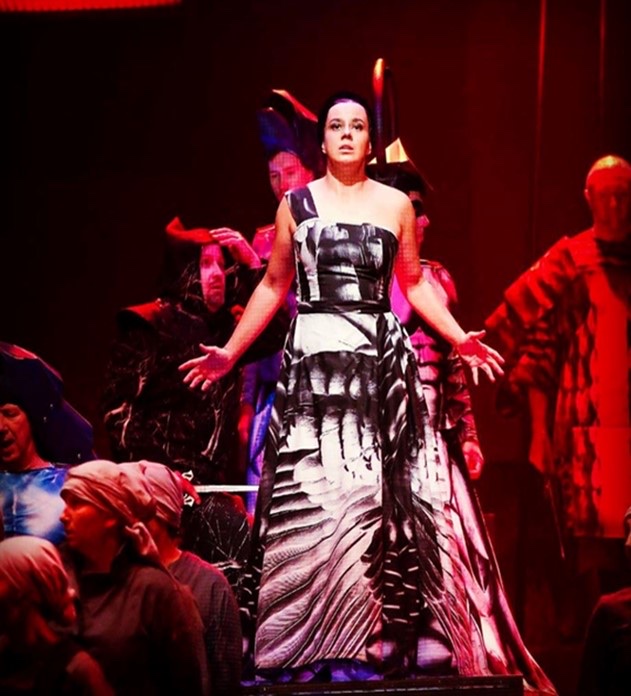
In recent years the artist has taken part in two world premieres on Poland’s leading opera stage. In October 2023 she sang in Krzysztof Meyer’s “Dead End” to a libretto by Antoni Libera, directed by Marek Weiss, in the triple role of the Secretary, the Mother Superior and Feminist III. The production was mounted for the composer’s eightieth birthday and was the first premiere of the 2023/2024 season.
In September 2025 she performed in the vocal octet in the world premiere of “The Best City in the World. An Opera about Warsaw” by Cezary Duchnowski, directed by Barbara Wiśniewska, co-produced with Sinfonia Varsovia and inspired by Grzegorz Piątek’s book about the rebuilding of the capital between 1944 and 1949.
Taking part in a world premiere means working on material nobody has performed before: without reference recordings, often with a score that is still changing, and in close contact with a living composer. It is the hardest form of reading music that exists in a singer’s profession, and a genuine test of musical independence.
Recitals, radio and television
In 2021 Elwira Janasik sang as a soloist with Capella Cracoviensis at the annual Fryderyk awards gala at the Opera at the Castle in Szczecin. In 2017, together with the pianist Jolanta Pszczółkowska-Pawlik, she recorded a recital for the TVP Kultura programme “Classical Stage”, and in 2022 she appeared in the “Chopin Marathon” broadcast live on Polish Radio.
She also performs regularly in chamber settings. In June 2025 she sang songs by Franz Schubert, Stanisław Moniuszko and Piotr Maszyński at a concert in the Museum of Romanticism in Opinogóra, alongside the soprano Anna Simińska, the bass Marcel Sas and the pianist Jolanta Pszczółkowska-Pawlik.
Duo with Jolanta Pszczółkowska-Pawlik
She has worked with the pianist Jolanta Pszczółkowska-Pawlik for well over a decade, and it is from this duo that her most important song recordings have grown. Working in a permanent chamber partnership teaches things that cannot be rehearsed in a classroom: listening to your partner, breathing together, sharing responsibility for tempo and mood. The artist brings those habits into her teaching, including when the pianist at the keyboard is someone the student met a week earlier.
Performance and multimedia projects
A separate and important strand of Elwira Janasik’s work lies on the border of opera, theatre and visual art. She appeared at the International Performing Arts Festival in Hamar in the performance “Tonus”, created together with Izabela Hamczyk. She also sings the mezzo-soprano part in “Gardens That Left Their Trees” by Sylwia Hanff’s Limen Butoh Theatre, a butoh opera for mezzo-soprano, cello, electronics, video and two dancers. The production premiered in 2015 and has been shown at venues including the Kubicki Arcades at the Royal Castle in Warsaw, the Dance Art Centre and the OFF Festival at the Akt Theatre in Grochów.
She collaborates with the Zdzisław Beksiński Foundation on concerts combining music with painting. She has performed Alfred Schnittke’s Requiem and “Sine Titulo” by Szymon Sutor, including at the concert “The World of Master Beksiński” in the Main Hall of the National Forum of Music in Wrocław in November 2021, as well as at the Spodek arena in Katowice and the Tauron Arena in Kraków.
Together with Jaga Hupało she created the video art piece “Misterium Antoni”, directed by Andrzej Miękus and built around Claudio Monteverdi’s Lament of Ariadne, in collaboration with the darkwave artist Miss God. The film has been shown at festivals including Olga Tokarczuk’s Mountains of Literature. The same collaboration produced the single “Lament of Dido”, released in 2022.
Discography
- Moniuszko, “Songs” vol. 1 and vol. 4 (2014 and 2019, Pawlik Relations), with Jolanta Pszczółkowska-Pawlik,
- Stanisław Moniuszko, “Masses: D minor, E flat major, D flat major” performed by the Polish Radio Orchestra in Warsaw under Michał Klauza (2019, Polish Radio),
- “Polish Patriotic Carols” in arrangements by Mariusz Dubrawski and Włodzimierz Korcz (2020),
- “Lament of Dido”, a single by Miss God featuring the artist (2022).
Classical singing lessons in Warsaw
Lessons are individual and the programme is built around the particular person. Working with a teenager preparing for entrance exams is different from working with an adult who finally wants to sing a favourite aria, and different again from working with someone who uses their voice professionally and needs to take the strain off it. The starting point is always the same: breath, freedom in the vocal apparatus and a healthy sound.
What the first meeting looks like
The first lesson is above all about getting to know the voice. A few simple exercises show where the comfortable part of the range lies, how the breath is working, whether there is tension in the neck and jaw, and how the voice responds to a change of vowel. On that basis we decide where to start and what repertoire makes sense for the coming months. Nobody needs to prepare for this meeting or bring music, although if you have a piece you would like to sing, do mention it.
What singing lessons cover
- setting the breath and the support, and work on freedom in the larynx and jaw,
- voice production, evening out the registers and gradually extending the range,
- resonance and carrying power, that is, the ability to sing freely and still be heard,
- diction and pronunciation in the languages of the classical repertoire: Italian, German, French and Polish,
- work on phrase, text and character, so that a performance is not merely technically correct,
- reading notation, basic theory and aural training to the extent a singer needs,
- working with a pianist and breathing together in a duo,
- preparation for auditions, competitions and examinations, including ABRSM exams,
- stage presence and dealing with nerves, drawn from experience in rehearsals and performances,
- vocal hygiene: warming up, warming down, rest and what to do during an infection.
Repertoire in lessons
Choosing repertoire is one of the most important decisions in learning to sing, and it is very easy to get wrong. An aria that is too difficult can block progress for months, while a well-chosen piece does half the teacher’s work. We usually begin with early Italian arias and simple songs, which allow work on legato without straining the voice. Then come songs by Moniuszko, Schubert and Brahms, oratorio arias by Bach and Handel, Mozart roles, and, given the right vocal material, romantic repertoire and twentieth century music.
Who classical singing lessons are for
We welcome teenagers considering a music school or a conservatoire, adults starting from scratch, amateur singers from choirs and ensembles, and those who already have a technique and want to put it in order before a specific performance. A separate group are people who use their voice professionally, for whom singing is a route to a more resilient and less tiring speaking voice.
You can join Unisono at any point in the year, because we work to our own curriculum, without marks and without a rigid semester calendar. The school has run continuously since 2008 and teaches children, teenagers and adults.
If jazz and popular repertoire is closer to what you are looking for, do take a look at the singing lessons with Alicja Gasparska. Elwira Janasik teaches the classical path: opera, oratorio, art song and early music.
Preparation for exams and auditions
Preparing for an entrance exam or an audition is a separate kind of work, laid out over time. The programme has to be chosen in advance, contrast has to be built between the pieces, you have to plan when the repertoire should peak, and the walk onto the stage itself needs rehearsing. We run trial performances in conditions close to those of the exam, because a first encounter with a panel should not also be a first encounter with nerves. Our teachers also prepare students for ABRSM examinations, with which Unisono works as one of the few institutions in Poland.
Frequently asked questions about learning to sing
At what age can singing lessons begin?
The voice matures later than instrumental technique, so regular work on voice production usually starts in the teenage years, after the voice has broken. Younger children are taught more cautiously, with the emphasis on ear, intonation and musicality rather than on loading the voice. For adults there is no upper age limit, and starting from the beginning is entirely normal in this group.
Do I need to read music to start?
No. Reading notation comes during the course, together with the basics of theory and aural training. What counts in the first lessons is above all how the breath works and how the voice responds.
Do I have an ear for music, and am I suited to singing?
The great majority of people who say they have no ear simply have an ear and a voice that are not yet coordinated. That is a matter of training rather than talent, and it can usually be improved within a few months of regular work. Genuine amusia is rare.
How often should I practise between lessons?
With singing, less is more. Twenty minutes of attentive work a day will do more than two hours once a week, after which the voice is tired for days. In the lesson we decide which exercises should enter the daily routine, so that practice at home reinforces the good habits rather than the unwanted ones.
Do singing lessons help people who use their voice at work?
Yes. Teachers, lawyers, actors and trainers often come to us with hoarseness and vocal fatigue. Work on breath, support and resonance takes the strain off the larynx and, along the way, improves diction and the carrying power of the speaking voice.
Will classical singing harm me if I also sing other repertoire?
No, provided it is taught sensibly. Classical technique gives stamina, breath control and an even sound across the whole range, and that works in your favour whatever the style. What changes is the delivery and the aesthetic, not the foundation.
Enrolment for singing lessons with Elwira Janasik
Lesson times are arranged individually and we try to fit your schedule. Details of the lessons and the enquiry form can be found on our contact page. You are also welcome to visit the gallery with recordings of our students’ performances and to meet the rest of the Unisono teaching staff.