
Kaja Morawiec is a flautist and chamber musician, an orchestral player, and for several years now also a flute teacher, both in music schools and in private practice. At Unisono Music Academy she gives individual transverse flute lessons to children, teenagers and adults, from the very first note through to preparing a programme for an exam or an audition.
Her daily practice is orchestral and chamber playing, and alongside it she studies the baroque traverso and historically informed performance. Two perspectives therefore meet in her lessons: the modern transverse flute with its full repertoire from the classics to film music, and the early instrument that shows where the sound we know today actually came from.
That second perspective is rare among flute teachers in Warsaw. Playing the traverso means drawing a sound from an instrument with six holes and a single key instead of a dozen or more, where every chromatic note requires its own cross-fingering and an adjustment of the embouchure. Anyone who works through that hears intonation differently, and talks about it differently with students.
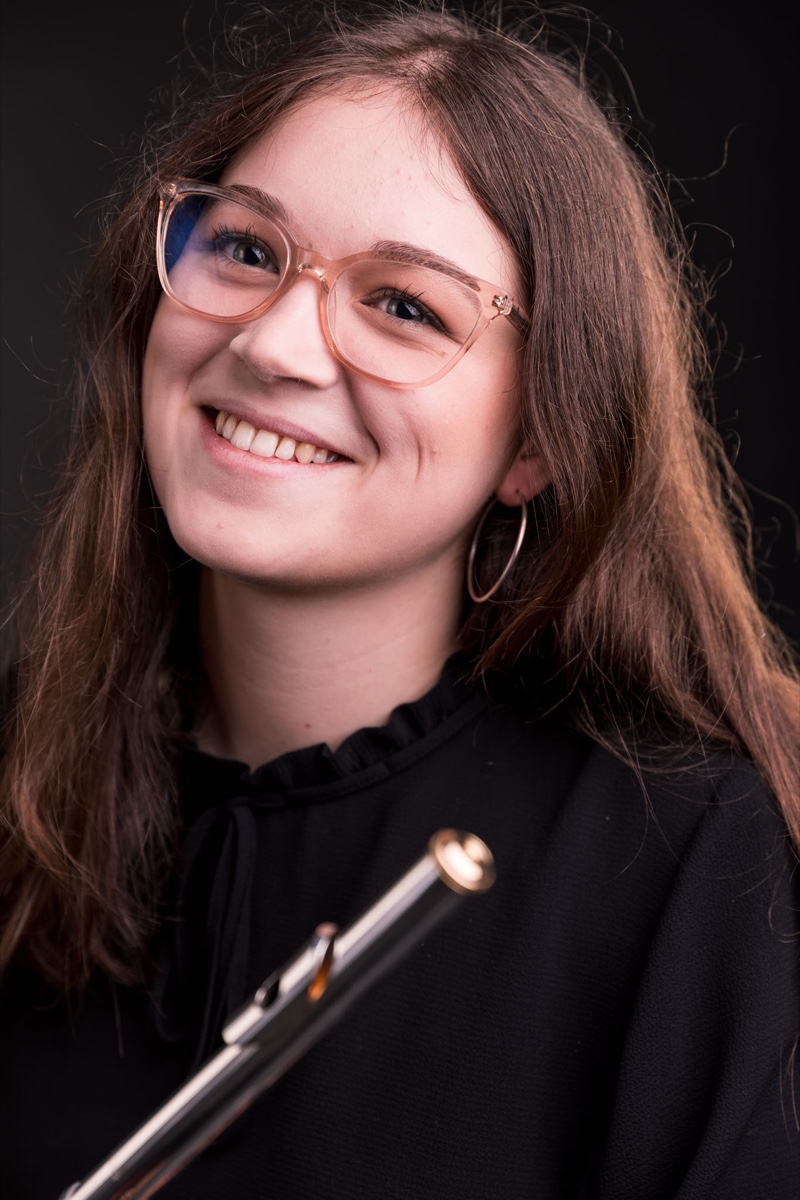
Kaja Morawiec, flautist and chamber musician
Behind her are the Katowice music school and studies at the Chopin University of Music in Warsaw; ahead of her, another degree, this time in baroque traverso. Along the way she has played in several Polish symphony orchestras, appeared at the National Philharmonic and at the Warsaw Autumn festival, and won a distinction at an international competition in Istanbul. The main points of that path are below.
Musical education
She began at the Wojciech Kilar State Music School Complex in Katowice, where she studied from 2014 to 2020. She then read music at the Fryderyk Chopin University of Music in Warsaw, completing a master’s degree in 2025 in the flute class of Professor Urszula Janik-Lipińska. She marked her graduation with an appearance at the UMFC graduates’ chamber concert in the Chamber Hall of the National Philharmonic in June 2025, performing Lowell Liebermann’s Sonata for flute and piano op. 23 with the pianist Marianna Waszkiewicz.
She is currently in the third year of a bachelor’s degree in baroque traverso, in the class of Dr Karolina Zych. This is a second, parallel course of study, run by the Early Music Department at the Chopin University of Music.
Orchestral experience
Kaja Morawiec has worked with many Polish symphonic ensembles:
- the Chopin University of Music Symphony Orchestra,
- the Silesian Philharmonic,
- the Płock Symphony Orchestra,
- the Polish Sinfonia Iuventus Orchestra named after Jerzy Semkow,
- the Orchestral Academy of the National Forum of Music and the NFM Wrocław Philharmonic,
- the Polish Radio Orchestra.
In the 2024/2025 season she took part in the Orchestral Academy of the National Forum of Music in Wrocław, a programme for young instrumentalists selected on the basis of submitted recordings, covering individual lessons with section leaders, sectional rehearsals, orchestral rehearsals and practical work with the NFM Wrocław Philharmonic. For a flute teacher this is valuable experience, because orchestral work demands entirely different skills from solo playing: counting long rests, entering on time after dozens of bars of silence, tuning against the oboes and reading quickly at sight.
Concert halls and festivals
As an orchestral and chamber musician she has performed in the most important Polish concert halls, including the National Philharmonic, the Silesian Philharmonic and the home of the Polish National Radio Symphony Orchestra. She has taken part in festivals such as Szalone Dni Muzyki and the Warsaw Autumn, where the contemporary repertoire calls for a great deal of precision and tonal courage.
Chamber music: harp duo and wind quintet
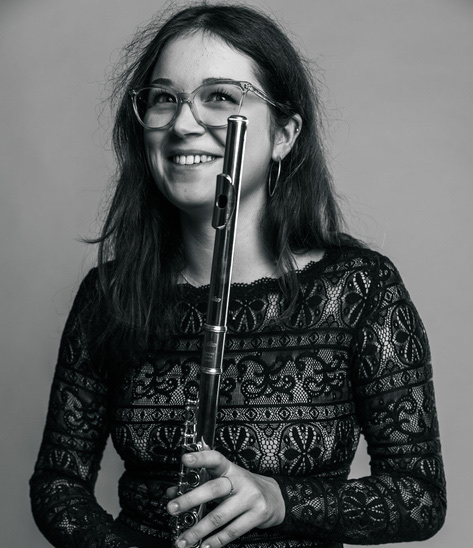
Chamber music is the field in which she feels most at home. She forms a duo with the harpist Olga Ucieklak, with whom in January 2025 she won a distinction in the chamber competition of the 2nd Ceren Necipoğlu International Harp Festival in Istanbul, held at the city’s Atatürk Cultural Centre. The same duo had previously been distinguished at the 10th International Harp Duo Competition.
Flute and harp is a pairing of exceptional colour, written for by Mozart, Fauré and Saint-Saëns among others. In September 2025 the two musicians appeared together with the soprano Marta Hohlweg-Grzelak in the concert “Music of Angels” at the Sanctuary of Our Lady of Leśna in Leśna Podlaska, with a programme covering Bach, Caccini, Debussy, Fauré, Saint-Saëns and Spohr.
She also plays in a wind quintet, with which she took second prize at the Polish National Competition for Wind Chamber Ensembles. The quintet of flute, oboe, clarinet, horn and bassoon is the best school of listening and intonation a wind player can have, because every voice sounds different and there is nobody to hide behind.
Early music and the baroque traverso
As a baroque flautist she performs with the instrumental ensemble of the Early Music Department at the Chopin University of Music. She has played in the concert “Thesaurus Musicorum Poloniae” with music by Adam Jarzębski, Marcin Mielczewski and Georg Philipp Telemann, in “An Evening of Early Music” with repertoire by Scarlatti, Bach, Handel and Purcell, and in the programme “À la française” devoted to the French baroque, with music by Marc-Antoine Charpentier and Jean-Baptiste Lully.
In September 2025 she gave a traverso recital at the Dramma per Musica Festival in the concert “Vive la jeunesse!”, together with Łukasz Olechowski on baroque viola, Olga Borzyszkowska on baroque cello and Marta Urbanowicz at the harpsichord. The programme included works by Jean-Philippe Rameau, Michel Blavet, Joseph Bodin de Boismortier, Telemann and Carl Philipp Emanuel Bach.
She has also appeared at Traversjada, a Polish national academic and artistic session devoted to historical transverse flutes, where she gave a recital with the harpsichordist Dr Dagmara Tyrcha.
Competitions and awards
- second prize with her wind quintet at the Polish National Competition for Wind Chamber Ensembles,
- distinction in the chamber competition of the 2nd Ceren Necipoğlu International Harp Festival in Istanbul (2025),
- distinction at the 10th International Harp Duo Competition,
- second round of the 1st Inter-University Competition for Instrumental Miniatures,
- participation in the Dutch International Flute Competition and in the 2nd Eugeniusz Towarnicki International Flute Competition.
Masterclasses
She has refined her craft at numerous masterclasses, both with leading Polish flautists such as Antoni Wierzbiński, Agata Igras, Andrzej Krzyżanowski, Ewelina Zawiślak and Ewa Murawska, and with internationally recognised musicians: János Bálint, Dejan Gavrić, Mario Caroli, Aldo Baerten, Carlos Bruneel, Philippe Bernold, Maria Graf and Tobias Koch.
Each of these teachers represents a slightly different school of embouchure and a different approach to sound, from the French care for colour to German precision of articulation. Bringing those experiences together means that when a problem comes up in a lesson there is something to choose from, instead of repeating the one solution that happens not to work for this particular student.
Flute lessons in Warsaw
Learning the transverse flute begins with the things nobody sees on stage: breathing, the setting of the embouchure and patient work on tone. Kaja Morawiec teaches one to one, and adjusts the pace and the repertoire to the particular person, without comparisons to others and without the pressure of marks.
What the first lesson looks like
At the first meeting we look at how the whole apparatus works: posture, the way the instrument is held, the setting of the lips and whether the breath goes down low. Complete beginners usually produce their first note the same day, often on the headjoint alone, before we assemble the whole instrument. If someone already plays, we listen to a prepared piece and decide what needs fixing most urgently. You leave the first lesson with a concrete practice plan for the coming week.
What flute lessons cover
- posture, diaphragmatic breathing and work on the embouchure, the foundation of an even tone,
- finger technique, single and double tonguing, scales and exercises,
- intonation and tone colour across the registers of the instrument,
- vibrato, dynamics and phrasing,
- reading notation, basic music theory and practical aural training,
- repertoire from the baroque through the classics and romantics to contemporary, film and popular music,
- playing with accompaniment and in a chamber ensemble, including work on orchestral parts,
- a daily practice routine matched to the time you realistically have in a week,
- preparation for auditions, competitions and ABRSM examinations,
- ongoing help for music school pupils with the programme set by their own institution.
Repertoire in flute lessons
The flute has one of the richest bodies of literature among wind instruments, and few people realise this at the start. We begin with simple melodies and studies, but within a few months it is possible to reach for a Handel or Telemann sonata, which sounds good even in a beginner’s hands. Beyond that the whole eighteenth century opens up with Bach, Mozart and Quantz, then romantic miniatures, the French school with Fauré, Debussy and Poulenc, and the repertoire of the twentieth century. Separately we work on whatever the student wants to play, from film themes to Irish music or jazz standards.
Traverso and early music
The traverso is the wooden predecessor of today’s flute, the instrument Bach, Telemann and Quantz wrote for. It has fewer keys, a different embouchure and a distinctly warmer, more speech-like colour. Students interested in historically informed performance can learn the basics of traverso playing with Kaja Morawiec, along with the musical rhetoric of the baroque and the rules of ornamentation, the art of decorating a melody that in the eighteenth century was expected of every performer.
This is a rare offering among private music schools in Warsaw, and at the same time an excellent school of listening for flautists who play the modern instrument. A few months of work on the traverso can change the way you play Bach on a silver flute, and change it for good.
Who flute lessons are for
We welcome children wanting to try their first wind instrument, music school pupils who need support with their current programme, teenagers preparing for entrance exams, and adults, including those returning to the flute after years away. That last group is larger than people expect, and usually makes rapid progress, because they come back already understanding notation and with a clear goal.
You can start at Unisono at any point in the year, because we work to our own curriculum and exclusively one to one, without marks and without a rigid semester calendar. We also help with choosing a first instrument.
Which flute to buy at the start
For the first months a decent student instrument in silver-plated brass, with closed holes and an offset G mechanism, is entirely sufficient. Closed holes are easier for beginners, because the finger does not have to land perfectly in the centre of the hole. It is worth avoiding the cheapest flutes from unreliable sources, since leaking mechanics can discourage even the most motivated player and make it harder to develop the embouchure. For children under ten a curved headjoint is a good solution, shortening the instrument and allowing a natural playing position. Before buying, simply ask in a lesson, because matching the instrument to the student’s hand and age saves a good deal of money and frustration.
Frequently asked questions about learning the flute
At what age can a child start playing the flute?
Most often around the age of seven or eight, when the child can reach the keys and has enough breath to sustain a note. A flute with a curved headjoint helps younger pupils, shortening the instrument and allowing a comfortable position. The age is not fixed, since a great deal depends on hand size and height.
Is the flute a difficult instrument to begin with?
The first note usually comes out in the first lesson, which is highly motivating. After that it takes patience, because an even sound across the whole range is built over months. The flute forgives less than people expect, but it repays regular practice with progress you can hear quickly.
How much practice is needed between lessons?
Better short and daily than once a week for two hours. For young beginners a quarter of an hour a day is enough; for more advanced players the time grows with the repertoire. We set the practice plan in the lesson, so that it is clear not only how long to play, but above all what to play and in what order.
Is playing the flute bad for the teeth or the lungs?
No. The transverse flute is a low-resistance instrument in which the air is split against the edge of the embouchure hole rather than forced under pressure, as in brass instruments. Braces do not rule out learning either, though the lips have to be re-set during the first period. Regular work on breathing generally improves stamina rather than harming it.
Can an adult start learning?
Yes, and it is one of the more common situations in our lessons. Adults learn differently from children: reflexes take longer to settle, but they grasp the point of an exercise far more quickly and can work consciously at home. With two or three quarter-hours of practice a week, the first pieces appear within a few months.
How does the transverse flute differ from the recorder?
The recorder, familiar from primary school, is held vertically and the sound is produced automatically, because the instrument has a built-in windway. On the transverse flute the player is responsible for forming the airstream, which makes the first weeks harder, but the dynamic and tonal possibilities are incomparably greater. Experience with the recorder helps, because the fingerings are partly similar and the notation is read in the same way.
Enrolment for flute lessons with Kaja Morawiec
Lesson times are arranged individually and we do our best to fit your daily schedule. For details and the enquiry form please visit our contact page. Recordings of our students’ performances can be found in the gallery, and the profiles of our other teachers on the teachers page.