The cello has a reputation for being a difficult instrument, and in part that is fair. It has no frets, so every note has to be found by ear and by hand, and the bow forgives less than a piano key does. In return it has one quality that cannot be imitated: it sounds in the range of the human voice. Students usually mention this after the first few weeks, when they draw their first full, long note and suddenly hear the instrument answering them.
A working orchestral cellist
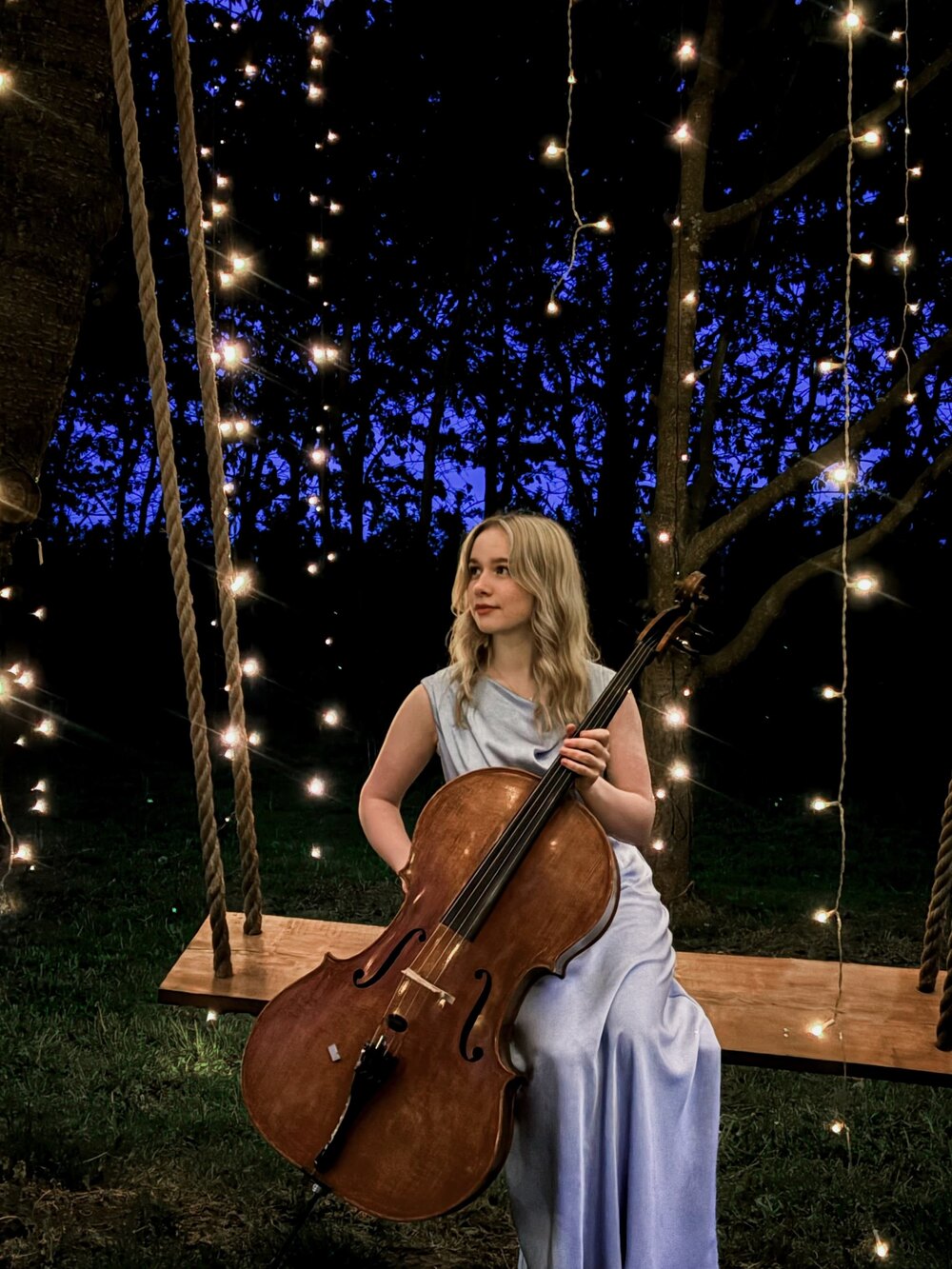
Marcelina Wojton is a practising cellist. She performed with the Gorzow Philharmonic. This matters directly in the teaching room, because when she talks about intonation, bow control or counting rests, she is describing something she does professionally every week.
She has previously played with the Katowice Academic Symphony Orchestra and the Afidare Musicae Symphony Orchestra, where she accompanied finalists of the International Chopin Piano Competition, among others. She has appeared at the Silesian Opera in Giacomo Puccini’s “Gianni Schicchi” and in Giuseppe Verdi’s Requiem during the Metropolitan Choral Festival. In 2023 she was principal cello at the Summer School of the Karol Szymanowski Krakow Philharmonic.
Musical education
She began the cello at the Ignacy Jan Paderewski School of Music in Krosno, where she studied for twelve years, from 2010 to 2022. She completed her bachelor’s degree in 2025 at the Karol Szymanowski Academy of Music in Katowice, in the cello class of Dr Arkadiusz Dobrowolski, and she is now reading for her master’s degree in the same class.
Alongside her performance studies she has been taking the Academy’s teacher training course since 2022. That distinction is worth asking any teacher about: playing an instrument well and teaching it well are two different skills, and the teacher training course is the formal preparation for the second of them.
Courses and masterclasses
In 2025 she took part in the European Masterclasses and the Akademifestivalen in Stockholm, run by the Royal College of Music there. The year before she attended the International Cello Academy in Nysa. She has worked in masterclasses with cellists including Mats Lidstrom, Roman Jablonski, Peter Bruns, Graham Waterhouse, Teresa Kaminska, Adam Krzeszowiec and Aleksander Gebert.
For a student that list has a practical meaning. Each of those teachers holds the bow slightly differently, distributes the weight of the arm differently and explains vibrato differently. A teacher who has gathered several schools of thought has something to fall back on when one way of explaining a thing does not reach a particular student.
Chamber music and the Ilarita Quartet
Marcelina Wojton plays in the Ilarita String Quartet. The ensemble won third prize at the Academic Chamber Music Competition at the Katowice Academy of Music and third prize at the OPUS International Music Competition in Krakow. In 2025 the quartet represented Poland at the Europa-Tage der Musik in Passau, performing quartets by Szymon Laks and Stanislaw Moniuszko, and the recording of that appearance was broadcast by Bayerischer Rundfunk.
Playing in a quartet teaches things that cannot be practised alone at a music stand. You have to listen to three other people, hold a shared tempo and know when to give way as the melody passes to another voice. Students who have played even one duet usually ask for another themselves.
Cello and singing
Away from classical music, Marcelina Wojton plays the cello and sings with Kapela Spod Rubani, a band performing Lemko songs and original sung poetry. The group has released two albums, “Kapela Spod Rubani” and “Gdy klania sie nam swit”. At the BAZUNA national student song festival in Gdansk she took first place, the Best Performer award and the Audience Award, and she has also won first prizes at the Wojtek Belon national song festival in Busko-Zdroj and at the Bakcynalia songwriting festival in Lublin.
For students this is a real advantage. A teacher equally at home in Verdi’s Requiem and in a song with a guitar does not treat popular repertoire as a lesser category. If someone comes to the cello because they heard a piece in a film or a game, they will get it arranged for their level rather than a lecture about working through the studies first.
Learning the cello in Warsaw
At Unisono Music Academy, Marcelina Wojton gives individual cello lessons to children, teenagers and adults. Classes take place at our premises at ul. Konstancinska 9 flat 1 in the Mokotow district of Warsaw, and times are arranged individually. She teaches in Polish and in English.
You do not need your own instrument to begin. Cellos come in fractional sizes, from one eighth upwards, and matching the right size to a child’s height is one of the first things we discuss. We will also help you hire an instrument for the first stage of learning.
The first lesson
The first meeting is exploratory and needs no preparation at all. We look at the shape of the hand, the length of the arms and how the student responds to sound. We talk about the music they listen to, what they want from lessons and how much time they can realistically give to practice at home. That last piece of information matters more than it appears to, because the pace of the coming months depends on it.
On the cello the first weeks go on two things, and it helps to know that in advance. The first is posture: the instrument rests against the body, so the height of the chair, the length of the endpin and the angle of the neck decide whether the back aches after twenty minutes of practice. The second is drawing the bow on open strings, without the left hand at all. It looks modest, but that is where the sound comes from that you hear later in every piece.
Who these lessons are for
Marcelina Wojton has taught children, teenagers and adults. You can sit down to the cello at six and you can equally do it at fifty, but the plan looks completely different. A child needs short tasks and a frequent change of stimulus, while an adult usually prefers to understand why an exercise makes sense before repeating it a hundred times.
We work to our own curriculum, without marks and without a rigid semester calendar. The repertoire is chosen for the individual student and the pace follows what they can do, rather than the other way round. Several times a year we hold student concerts at the Szuster Palace on Morskie Oko street in Mokotow. Performing is not compulsory, but it is usually what makes the biggest difference to how a student works at home. Those who wish to can also be prepared for the international ABRSM examinations.
Enrolment for cello lessons
You can begin in September, but equally at any other point in the year. You can read about all of our teachers on the teachers page and find recordings from earlier concerts in the gallery. For available times and further details, please get in touch.